Posted on

“A.I. Flies Your Aircraft” can be much more than just a movie

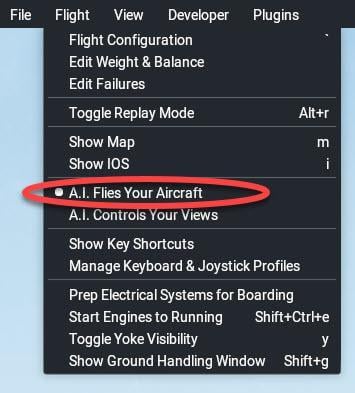
You can allow the AI system to fly your aircraft by clicking A.I. Flies Your Aircraft from the Flight drop-down menu and watch the A.I. fly the aircraft without any input from you. But there is much more to this than you might think.

If you begin your flight with “Start with engines running ” unchecked (You start from “cold and dark”) and then instruct A.I. to fly your aircraft: 
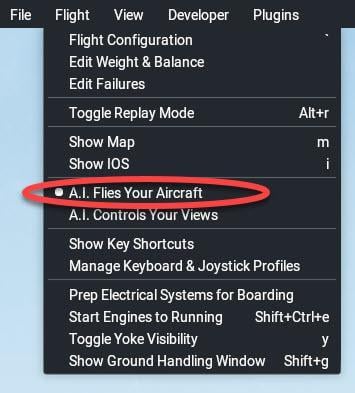
image.jpeg

After a while A.I “wakes up” – this happens almost immediately at small airstrips and can take quite a while at large airports.

You can then watch the cockpit settings change, knobs move, switches click, ATC initiates a conversation, and your flight begins.

You may be a spectator, but you can learn a lot about ATC, taxi speeds, flap settings, etc. You can pan around, zoom in on different settings, hop outside, or look closely at the ATC conversation. 

The other useful thing about having AI fly your aircraft is that it can give you an idea of how well your system is performing and whether the AI pilot encounters the same problems as you. 

Watch how AI handles the take-off run. Can you keep the aircraft from veering across the runway like the AI pilot can? This will give you a yardstick to aim for. 

In addition, since A.I. does not use your peripherals but the X-Plane engine itself, if you just cannot control the aircraft as well as A.I. does, it can give you a hardware fault-finding clue. Maybe your rudder pedals need attention or need to be calibrated. Maybe your sensitivities need adjustment (See this post). Maybe your throttles are not traversing their full extent…

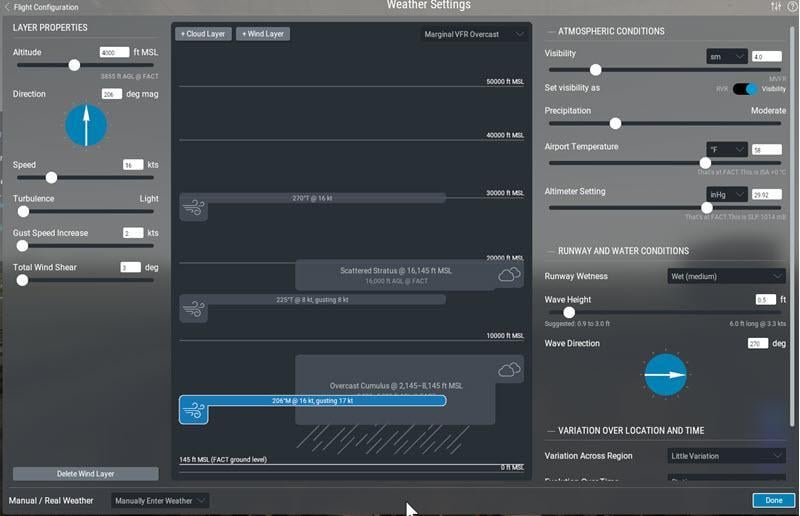
image.jpeg
Posted on

Watch how ATC works

If you are a new user of X-Plane, learning to fly properly, and you are confused about how ATC works, X-Plane can help you by showing you how it is done.

Start a new flight from any metropolitan airport (Mid size – not an airstrip but not a large international). Choose a small GA aircraft. Ideally, in an area you are familiar with in real life.

Set the weather to “Marginal VFR Overcast” and precipitation at “Moderate”. Set a wind speed of  16kts at an altitude of 4000ft

WeatherSettings.jpg

Click “A.I. Flies Your Aircraft” from the Flight pull-down menu:

ai flies pull down.jpg

After a while, the aircraft will come to life, and you will see the ATC panel. A.I. will choose a destination airport and will automatically take off, fly the route and land. All you need to do is watch the ATC conversation and see what ATC says,  how the AI pilot replies, and then how “he” reacts. It is particularly useful to do this in cloud conditions where you cannot see the ground and quickly lose orientation. Watch how the A.I. pilot relies on instruments and ATC instructions. Watch how quickly the A.I. obeys ATC.
Once the flight is complete, try it yourself without A.I.
Remember to “read back” every communication ATC sends you.

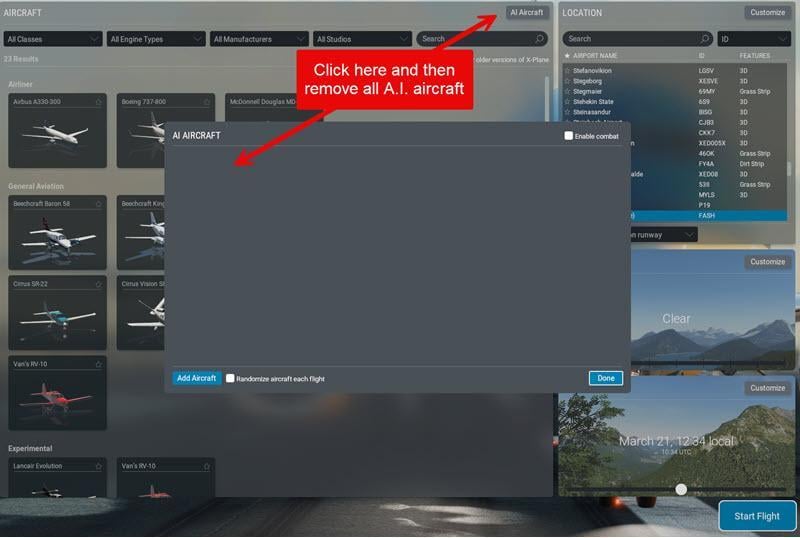
Note – when trying this tip, set the number of A.I. aircraft to zero.

RemoveAIAircraft.jpg

When there are many A.I. Aircraft around, ATC often gets very slow.

Posted on

Plane spotting? Don’t park on the runway!

If you like plane-spotting and enjoy just watching the AI aircraft taxi-ing, taking off and landing and just generally experiencing the airport’s ambience without actually flying, don’t park on a runway or begin a flight from the end of a runway. If you do, X-Plane will act in a logical manner and wait for you to take off. AI activity will come to a stop while X-plane waits for you. If you are in the “ready for takeoff” position you may well find that an aircraft creeps up behind you and just stops and waits. Or sometimes all AI activity just simply stops. 
If you want to watch aircraft, rather park well off a runway, or even better, simply stay at your gate, press the C-30x30.jpg key for free camera movement, and “walk” about using your keyboard and right-mouse button.

Posted on

Fix ATC Mid-flight

Sometimes, ATC does things that you are not happy with. It may “forget” to give you vectors or descent instructions; it may get choked up if too many AI aircraft are in the vicinity; it may get confused by a buggy airport… Conversely, sometimes ATC is quite correct, but you did something wrong with your flight plan, or did not read back, or did your own thing, or maybe you were “naughty” and got warned too many times: “Don’t transmit when the channel’s busy”.
To fix a sulky ATC, try asking for flight-following (if ATC will listen to you) and then canceling the flight-following service. Then, file a new plan (while in flight) and ask ATC for clearance. Hopefully, ATC will then behave itself.
Please remember that simulated ATC, in contrast to a real human controller (IRL or on Vatsim), is a mind-blowingly complex piece of programming. X-Plane’s ATC system is constantly undergoing big changes and improvements, so what does not work so well now may well work brilliantly after a few update cycles. If you compare ATC in the last version of X-Plane 11 with that of X-Plane 12 (current version), you will be amazed at the improvements.

Posted on

File flight plan with ATC before entering it into the FMC

Which comes first, the “chicken or the egg”?
When you are planning an IFR flight, it’s always a good idea to file your flight plan with ATC before actually entering it into the FMC. In the days when X-Plane had a far less capable ATC system it did not matter much when you filed a flight plan in the ATC window,. You would get it from the FMC. Now that SIDs and STARs are accepted by the X-Plane 12 ATC system, if you are entering the flight plan directly into the FMS first, there is a 50/50 chance that ATC will not accept the flight plan that you proposed. Maybe your desired runway is not in operation today (weather or some other reason) or maybe a waypoint is not recognized. Then you have to go right back to the planning stage and change things around to a greater or lesser extent.

If you first put in your SID, waypoints and STAR and ATC accepts them, then you can go to the trouble of entering it all into the FMS afterwards. If you are loading your FMS from the output of your flight planner and then filing it with ATC, you run into the same problem.

While not so convenient in X-Plane because you are a “one man band”, in real aviation the flight plan is actually entered into the FMS as late as possible – certainly after the flight plan has been filed. So this tip brings us a step closer to real aviation.

Posted on

How to see where is ATC directing me to

Sometimes we get strange course corrections from ATC which don’t seem to be logical.

ATC instructions.jpg

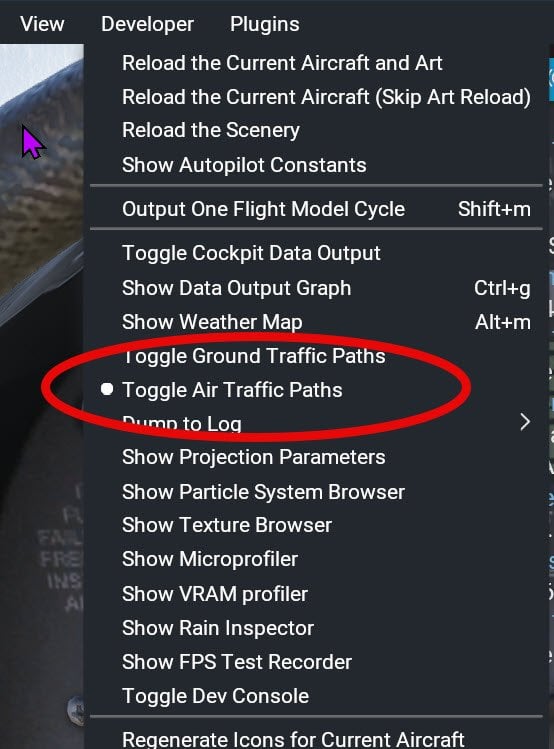
In order to get a visual indication of where ATC wants us to fly to, toggle on the option to show Air Traffic Paths. This is found in the Developer menu:

Developer menu air traffic path.jpg

Open Map view [M] and you will see a green line indicating the direction that ATC wants you to fly. The line begins at the current location of your aircraft. Every time ATC gives you a course correction, this line changes.

ATC intentions.jpg

Toggling this option off removes the green line from the map screen.

Posted on

Optional ATC choices

Sometimes strange things happen with ATC. For example, it can happen that ATC offers you the option to ask for a pushback when you are in a GA aircraft. Really? Maybe such an option appears because you are parked in a non-GA slot; or sometimes you have to be parked in a tie-down location; or sometimes the airport is just coded badly.

Some ATC requests are requirements, some are optional while a lot are just a bit confusing.
Some items like “request altimeter” or “Request Weather” or asking for a radio check are optional, but once you start using ATC, you are required to obey what it instructs you to do. If you don’t, it will usually first nag you a few times, and then curtly inform you that ATC services are being cancelled.

Above all, if you want to use ATC (it’s optional) make sure you are familiar with the ATC manual. You will find the X-Plane_ATC_System_Manual.pdf in your X-Plane installation: … X-Plane 12\Instructions.

Posted on

Too many active AI aircraft plays havoc with ATC

In the constant search for realism it is tempting to activate more than three AI aircraft. This can lead to all sorts of troubles with ATC.

Apart from your own aircraft there are three other possible types of aircraft found at an airport:

Static aircraft – These are simply non moving models and use very few resources. The just make the airport seem fuller.

Traffic aircraft – there are a number of traffic addons available – both freeware and payware which are controlled by the traffic add-on they are paired with. They move, taxi, take off and land but they are actually not connected to the X-Plane ATC system at all. They have relatively little effect on X-plane’s performance.

AI Aircraft – These are aircraft that are controlled by X-Plane’s ATC – with ever increasing intelligence. They are essentially the default aircraft of X-Plane itself. They even talk to ATC. The problem is that each additional aircraft uses a lot of extra resources and this extra load first becomes noticeable when ATC has long pauses before giving you instructions. Too many active AI aircraft also make conversation with ATC difficult because there is much more chatter, and you have to find a gap to send your message.

One or two AI aircraft should suffice with an absolute maximum of 3.

Posted on

When ATC makes no sense…

Did you know that when ATC give you weird instructions, you can actually discover what it has in mind.

Click the menu: Developer –> Toggle Air Traffic Paths. Now, to see what ATC has in mind, bring up the map view window [M] and you’ll see a green line representing the track that ATC wants you to follow.

This “map confirmation” of ATC intentions goes a long way toward re-assuring us that ATC has not forgotten all about us.

Posted on

Lost ATC window

Sometimes when the ENTER key is pressed to bring up the ATC window, it does not appear. It seems to be off screen. This frequently happens after a multi-monitor reconfiguration, resolution change, or display layout tweak.
The easiest way to force it back to the primary display is to clear or reset the stored window position preferences.
X-Plane saves dialog and popup coordinates in specific preference files. Deleting or renaming them forces X-Plane to recreate them with default, on-screen coordinates without wiping out your aircraft or controller profiles.

Quit X-Plane 12 completely.

Open File Explorer and navigate to your X-Plane 12 folder. (For example : C:\X-Plane 12)

Click the Output sub-folder, then open preferences (…\X-Plane 12\Output\preferences). Locate the following files (you’ll see one or both):

X-Plane Window Positions.prf
X-Plane Screen Res.prf

Rename them to

X-Plane Window Positions.prf.bak
X-Plane Screen Res.prf.bak

or simply move them to your desktop as a backup.

Restart X-Plane 12 and fresh preference files will be generated, pulling the ATC window to it’s default default position on the main screen.