Posted on

Fly-In – A treasure trove of flights

There is a thread on x-plane.org that has been going for many, many years – regularly every week – run by @Kumiankka . And yet, judging from the lack of discussions and comments on this huge forum as a whole, I suspect many forum users are actually quite unaware of it. The reason (I guess) is probably because the title suggests that it is an on-line flying/VATSIM sort of thread. This is definitely not the case.

Do yourself a favo(u)r and browse through this Fly-In forum, choose a flight that looks interesting and click on the discussion thread for that particular flight. There are literally hundreds of flights to choose from – the more recent flights are better illustrated and laid out than the earlier ones way back in 2004.
I guarantee this will open up a whole new world for those of you who have X-Plane set up and ticking nicely, and are now looking for inspiration about where to fly. Each flight contains a description as well as some comments and tips and often links to relevant freeware sceneries if you feel so inclined.
Posted on

Optional ATC choices

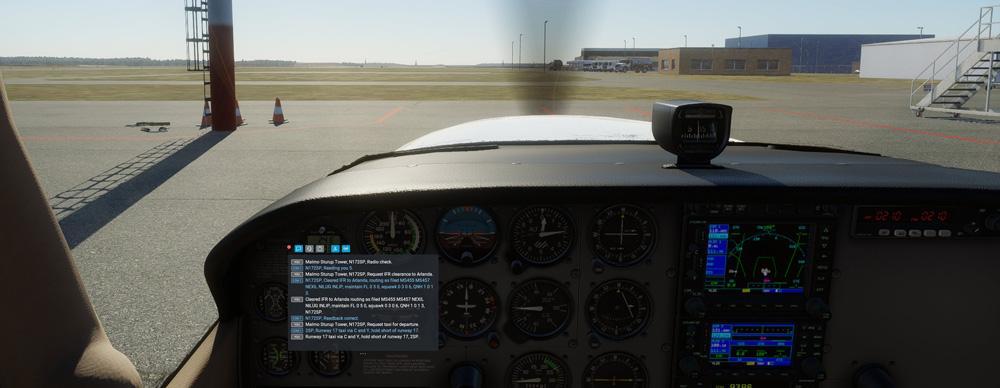
Sometimes strange things happen with ATC. For example, it can happen that ATC offers you the option to ask for a pushback when you are in a GA aircraft. Really? Maybe such an option appears because you are parked in a non-GA slot; or sometimes you have to be parked in a tie-down location; or sometimes the airport is just coded badly.

Some ATC requests are requirements, some are optional while a lot are just a bit confusing.
Some items like “request altimeter” or “Request Weather” or asking for a radio check are optional, but once you start using ATC, you are required to obey what it instructs you to do. If you don’t, it will usually first nag you a few times, and then curtly inform you that ATC services are being cancelled.

Above all, if you want to use ATC (it’s optional) make sure you are familiar with the ATC manual. You will find the X-Plane_ATC_System_Manual.pdf in your X-Plane installation: … X-Plane 12\Instructions.

Posted on

Older Versions of X-Plane

Sometimes we look through our collection of old but superb payware or freeware aircraft and would like to fly them again, but they are incompatible with X-Plane 12.
For example, did you ever get the sudden yearning to fly the DC6 from PDMG that was not ported over to X-Plane 12? It sure cost a bundle of money!

All is not lost… Did you know that you can download earlier versions of X-Plane and install them on the same computer as your X-Plane 12 installation. The different X-pane installations are completely separate and will happily co-exist on your computer, not affecting each other at all. You can install the demo versions of X-Plane 11, X-Plane 10 and even X-Plane 9. If you still have your X-Plane license key you can happily activate them as well. Click here to go to the download page for old versions

Posted on

Ever heard of the “bird” or Velocity vector in the Heads-Up Display?

Did you know that in the HUD (Heads Up Display) of most aircraft in X-Plane there is a tool that helps you to visually align your aircraft to the the runway touchdown point when you have a crosswind messing you around.

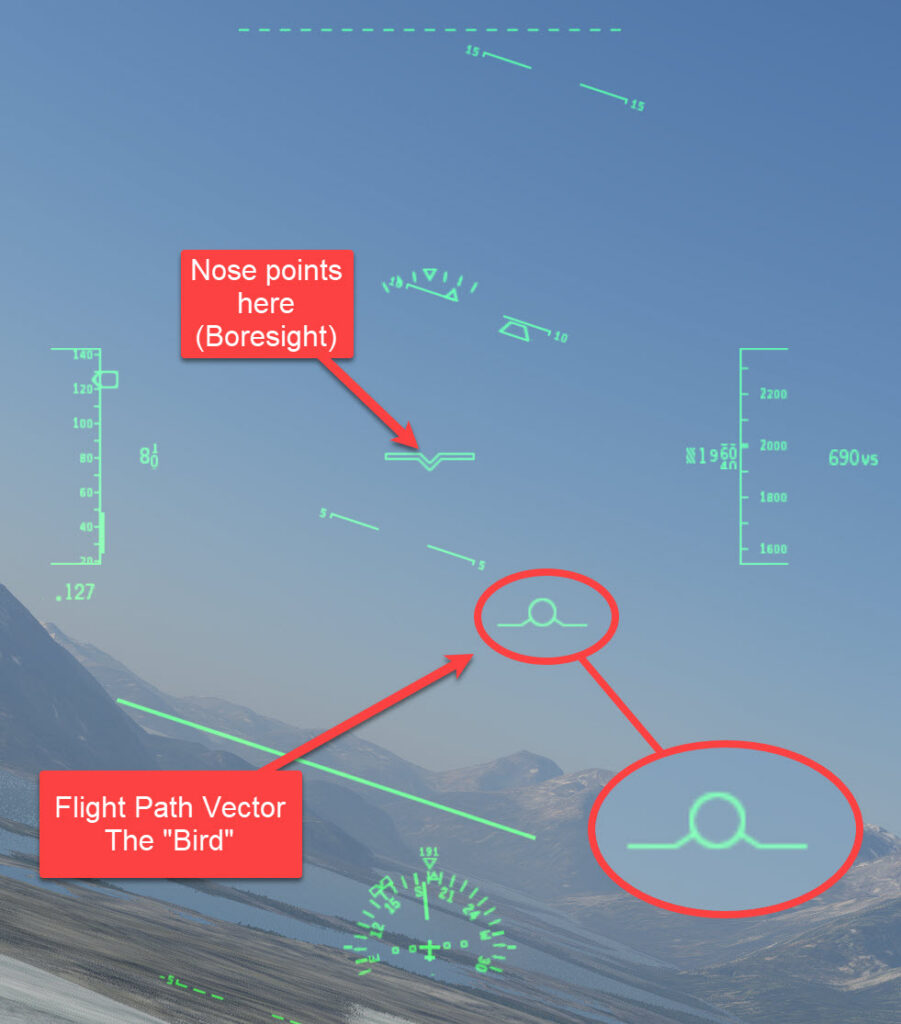
The Velocity Vector (often referred to as the Flight Path Vector or FPV, and represented on the HUD as a small circle with tiny wings, sometimes called the “bird”) is one of the most powerful instruments on a HUD in X-Plane.

Instead of showing where the aircraft’s nose is pointing (pitch and yaw), the velocity vector shows where the aircraft is actually physically moving relative to the outside world.

If there is a crosswind from the left, the velocity vector will be displaced to the right of the aircraft’s centerline/boresight cross.

To fly a precise ground track, you keep the velocity vector locked onto the desired meridian or runway extended centerline, rather than the nose symbol.

Posted on

Too many active AI aircraft plays havoc with ATC

In the constant search for realism it is tempting to activate more than three AI aircraft. This can lead to all sorts of troubles with ATC.

Apart from your own aircraft there are three other possible types of aircraft found at an airport:

Static aircraft – These are simply non moving models and use very few resources. The just make the airport seem fuller.

Traffic aircraft – there are a number of traffic addons available – both freeware and payware which are controlled by the traffic add-on they are paired with. They move, taxi, take off and land but they are actually not connected to the X-Plane ATC system at all. They have relatively little effect on X-plane’s performance.

AI Aircraft – These are aircraft that are controlled by X-Plane’s ATC – with ever increasing intelligence. They are essentially the default aircraft of X-Plane itself. They even talk to ATC. The problem is that each additional aircraft uses a lot of extra resources and this extra load first becomes noticeable when ATC has long pauses before giving you instructions. Too many active AI aircraft also make conversation with ATC difficult because there is much more chatter, and you have to find a gap to send your message.

One or two AI aircraft should suffice with an absolute maximum of 3.

Posted on

No more “Open Checklist” in X-Plane file menu

Did you notice that there is no more “Open Checklist” in the File menu drop-down of X-Plane12? I didn’t even notice when it was actually removed. True, it was a little limited, but for those who want to keep their installations “plugin free” that option just isn’t there anymore.

However, having stated the bad news, all is not lost. I presume one of the reasons for the removal is that there is a very good – very stable – absolutely no trouble – freeware – plugin available called XChecklist created by @sparker . If you have never seen this plugin, download it and try it out. There are many, many checklists published on this forum which are compatible with X-Checklist, so you are are bound to find one for your favourite aircraft. In fact, it is very easy to create your own checklist with nothing more than a humble text editor.

The plugin will work on Windows, Mac and Linux. And the good news is that it is far more capable than the original Laminar checklist.

Posted on

Ground speed fine control – Speedup the sumulation

Although no longer available from the pull-down menus, using the key combination [ALT]+[T] will double your ground speed, effectively relieving the tedium of a long flight.
[ALT]+[T] again will quadruple your ground speed,
[ALT]+[T] again will increase your ground speed 8x,
[ALT]+[T] again will increase your ground speed 16x,
[ALT]+[T] again will bring your speed back to normal (1x)

Did you know, however, that if you open the instructor station (press [I] or click “Show IOS” from the Flight pull-down menu), there is an analog(ue) ground speed slider. This slider allows you to reduce or increase ground speed without having to cycle through the higher speed levels to get back to 1x. It only goes as high as 6x but you can set any speed you like between 0x and 6x. It is particularly useful if you want to slow your ground speed below 1x or increase ground speed only slightly like 1.5x

Posted on

Cockpit goes dark

This is something which catches most of us at some stage. You are flying merrily along, steadily gaining height and suddenly… “oops” … I must have flown into an eclipse… Everything has gone dark… what did I do wrong now? you ask yourself. Is my PC overheating? … something has gone badly wrong…

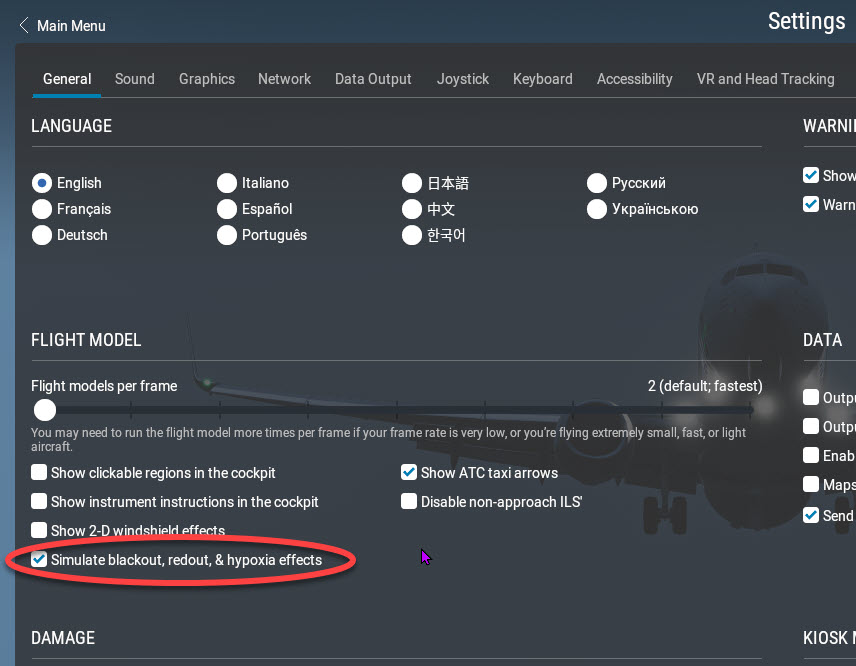
No nothing has gone wrong. You are flying a simulator which actually simulates … You need Oxygen… Hypoxia…

You can turn the effect off by un-ticking the checkbox in the Settings –> General page

Posted on

Finding the Taxi Arrows

When you are parked at a gate, you often cannot see the Taxi Route Arrows once ATC gives you permission to Taxi.

image.jpeg

Your first assumption is that there is no taxi-arrow indication available for this airport. However, that is very unlikely. Instead, you may well find that the arrows are behind you or obscured or too far away to see. The solution is to go into Free Camera mode by pressing the image.jpegkey and then use the arrow keys to rise right out of the cockpit and then look around:
image.jpeg

Here we find the arrows pointing back behind the aircraft.