Posted on

Decimal Degrees vs Degrees Minutes Seconds

X-Plane uses Decimal Degrees in the map view. However, many charts, maps, and geographical descriptions use degrees, minutes, and seconds. When studying navigation and plotting courses, we often need to convert between the two.

Here are two on-line calculators:

Latitude & Longitude Degrees Minutes and Seconds – to – Decimal degrees

Latitude & Longitude Decimal degrees – to – Degrees Minutes and Seconds

Posted on

Watch how ATC works

If you are a new user of X-Plane, learning to fly properly, and you are confused about how ATC works, X-Plane can help you by showing you how it is done.

Start a new flight from any metropolitan airport (Mid size – not an airstrip but not a large international). Choose a small GA aircraft. Ideally, in an area you are familiar with in real life.

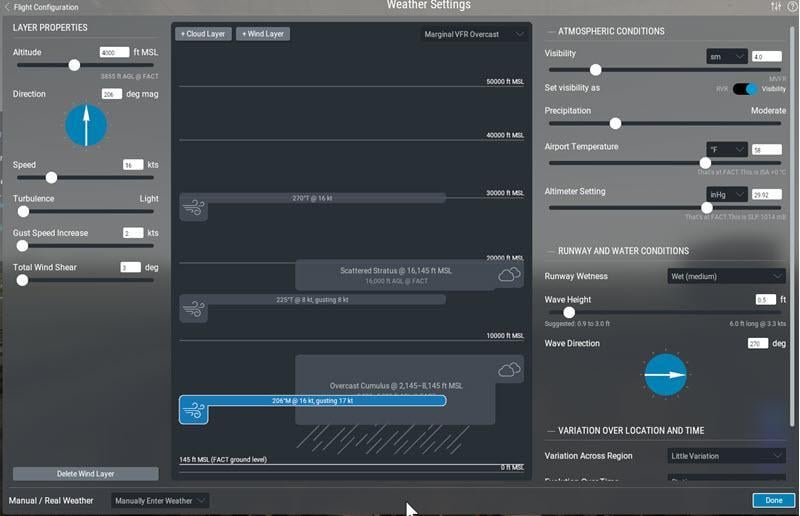
Set the weather to “Marginal VFR Overcast” and precipitation at “Moderate”. Set a wind speed of  16kts at an altitude of 4000ft

WeatherSettings.jpg

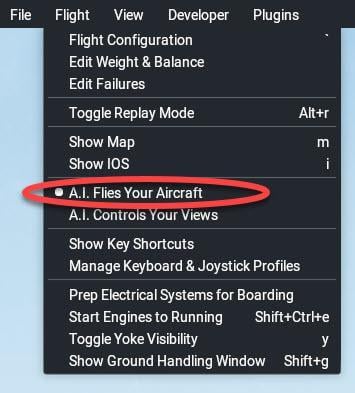
Click “A.I. Flies Your Aircraft” from the Flight pull-down menu:

ai flies pull down.jpg

After a while, the aircraft will come to life, and you will see the ATC panel. A.I. will choose a destination airport and will automatically take off, fly the route and land. All you need to do is watch the ATC conversation and see what ATC says,  how the AI pilot replies, and then how “he” reacts. It is particularly useful to do this in cloud conditions where you cannot see the ground and quickly lose orientation. Watch how the A.I. pilot relies on instruments and ATC instructions. Watch how quickly the A.I. obeys ATC.
Once the flight is complete, try it yourself without A.I.
Remember to “read back” every communication ATC sends you.

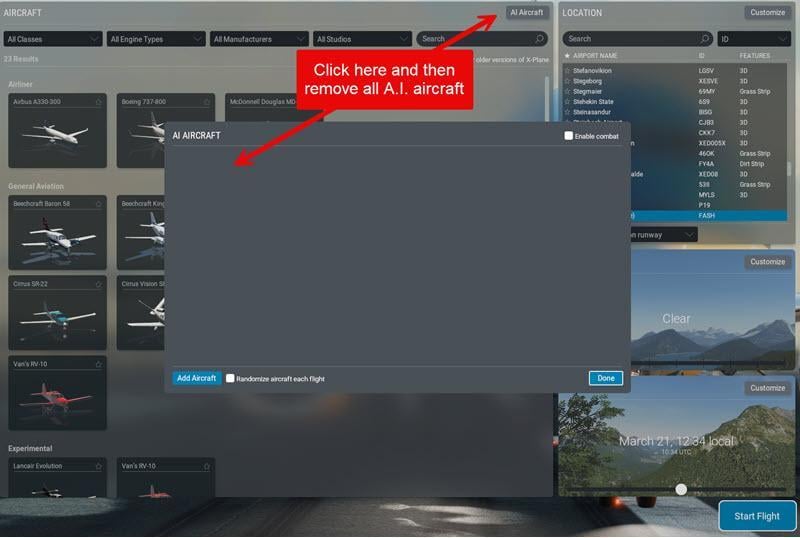
Note – when trying this tip, set the number of A.I. aircraft to zero.

RemoveAIAircraft.jpg

When there are many A.I. Aircraft around, ATC often gets very slow.

Posted on

Spongey Taxi-ing with the Default Cessna C172

Have you ever cursed X-plane and swore that the simulator was not working realistically when making an initial take-off run in a Cessna C172? It seems to do all sorts of ridiculous weaving.
I am not referring to the well-known fact that it pulls to the left and is quite correctly modeled – the spiralling slipstream propwash effect – but it might surprise you that the spongey effect of steering/correction/over-correcting with the nose wildly swerving left and right is also quite realistic. Essentially the reason for this spongey effect is because the real cessna 172 does not have a direct mechanical link to the rudder, but uses a spring-loaded system.
This effect is actually correctly modeled in X-plane despite your screaming at your yoke in frustration!.

For an explanation of what is actually happening, have a look at this article from the Cessna Owner Organization. There you will finally get an explanation for what you might initially have thought is a bad flight model or a faulty peripheral controller.

The solution? Firm but gentle pressure avoiding sharp yoke and pedal movements.

Posted on

Some Bullet-form Tips for Using X-Plane 12

Stability

  • Disable Unnecessary Plugins. Unused or incompatible plugins can tank performance. This is the #1 Stability tip of all time. Don’t just disable them; remove them from the directory hierarchy.
  • Optimize, but do not overclock your CPU or your graphics card
  • Cool your motherboard, RAM, and M2 SSDs. More than passive chassis fan cooling is required.
  • Use a UPS [UN-interruptible Power Supply] and an over-specced PSU [Power Supply Unit]

Graphics Optimization

  • Tweak Render Settings. Lower the visual effects (e.g., shadows, reflections, and antialiasing) if performance lags. Balance quality and frame rate for your hardware.
  • Try FSR (FidelityFX Super Resolution). X-Plane 12 supports AMD FSR, which can boost performance without significant visual loss.
  • Monitor VRAM Usage: High texture settings can overload your VRAM. Use the “Texture Quality” slider to optimize.

Aircraft Handling

  • Calibrate Controllers. Properly calibrate yokes, pedals, and throttle quadrants in the settings menu to ensure smooth aircraft control.
  • Adjust Control Sensitivity. Use the sensitivity sliders to fine-tune aircraft response, especially if it feels too twitchy.
  • Study the Flight Model Adjustment. X-Plane’s physics engine is advanced – experiment with “Flight Model per Frame” in the settings if you encounter unrealistic behaviour.

Weather System

  • Real Weather Accuracy. Ensure you’re connected to the internet for real-time weather updates. If the weather seems incorrect, force a refresh in the settings.
  • Adjust Turbulence Sensitivity. The new weather system is more dynamic. If turbulence feels overdone, tweak the realism sliders.

Customizing Views

  • Save Custom Camera Angles. Use the [Ctrl] + [number keys] to save cockpit or external views and quickly recall them with the corresponding number key.
  • Use Free Camera Mode. [c] or [Shift] + [4] activates free camera mode, great for screenshots or inspecting scenery.

Multiplayer and ATC

  • Use Default ATC. While not perfect, X-Plane 12’s ATC has improved tremendously over the past year. The latest update, 12.1.3 (about to be released – Time of writing: Late November), contains a huge ATC system update.
  • If you feel more confident, join online networks like VATSIM, IVAO, or PilotEdge for realistic ATC and multiplayer flying.

Posted on

LEARN HOW TO FLY – a Tip for Serious Beginner Aviators

Do you want to learn how to fly the RIGHT way? Well here’s a radical idea. Invest in an 80-year-old book!
I’m not Joking. In my humble opinion, the finest book ever written on the basics of learning to fly was written in 1944.

Title: Stick and Rudder
Author: Wolfgang Langewiesche

image.jpeg

You can get a hard copy version from Amazon

No, I don’t get a commission for recommending this – it’s just simply the best of the best

Or borrow it online for free from Internet Archive

Posted on

“Hidden” goldmine of information

Did you know that in addition to the Flight School section on the massive X-Plane.org site, there is a not-so-well-known treasure trove of downloadable tutorials in the downloads section. This section has nearly 300 downloadable tutorials written by .org members who have tried to give back to the community. While some of the tutorials are new “hot off the press”, some are nearly 20 years old but even the old ones retain some wise wisdom, wonderful explanations and great tips. They are not grouped in any particular way and it’s difficult to search because you are “digging for hidden treasure” and don’t necessarily know what to search for. Take the time to  browse through this repository, you find it’s well worth it.

Posted on

The difference between IAS, TAS, GS and CAS

Many new pilots get confused between the different types of airspeeds and how they affect your flying and navigation. Here is a concise easy-to-understand article from the Boldmethod site which clearly explains the difference.

Browse around their site for many other useful lessons on aviation topics. Being a teaching site, they are particularly good at explaining aviation concepts in an easy-to-grasp manner.

Posted on

The useful Freeflight.prf file

After each successful flight, X-Plane stores a whole lot of information from the flight of each aircraft you have flown with, which is used as starting data for the next flight. Its worth having a look into this file and see exactly what is saved there. The entries are sometimes somewhat cryptic, but it’s easy to figure them out. You can find this file in the …X-Plane 12\Output\preferences folder.

These entries can happily be changed (It’s just a text file) if you are unhappy with the numbers, or even deleted of they are screwed up. X-Plane will replace anything deleted with it’s default value.

For example, the fuel left over from the previous flight (shown in red), or the payloads (shown in Blue) of a particular aircraft (in this case the Cessna 172) is stored in these lines:

P _weight_and_balance _AircraftLaminarResearchCessna172SPCessna172SPG1000acf {“weight”:{“deicefluid_in_liters”:0.0,”deice_holdover_time_in_minutes”:0.0,”fueltank_weight_in_kilograms”:[39.641891479492188,39.641849517822266,0.0,0.0,0.0,0.0,0.0,0.0,0.0],”oxygen_pressure_in_millibars”:0.0,”payload_weight_in_kilograms”:[41.788509368896484,41.788509368896484,34.190597534179688,34.190597534179688,22.793731689453125,9.4973878860473633]}}

You can either change these values (don’t worry about the numbers after the decimal point),
or simply delete the whole entry and when you begin a flight with that particular aircraft X-Plane will load the aircraft with it’s default fuel (usually half-full tanks) and default payload.

Posted on

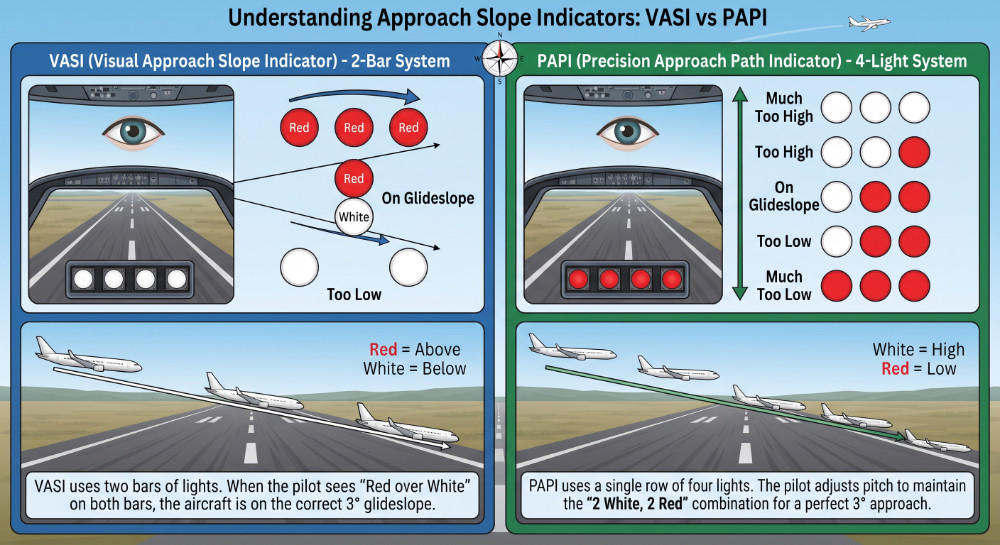
Using PAPI/ASI lights or Runway Aiming Points

Since most airports in X-Plane are fitted with fully functional PAPI or VASI lights, the question arises whether it is better to use them or rather use the runway aiming points. Here is a very simple, concise, but beautifully illustrated article on the Boldmethod site (aimed at real-world pilots) that is well worth the 5-minute read. Click here.